
A few days ago this was still a code-string rumor with a placeholder name. It isn't anymore. Apple announced HomeView on October 13, 2026, priced it, dated it, and put it in front of reporters at a dedicated "Welcome Home" event. It ships November 13. We don't have a unit yet, so this isn't a review and there's no score attached to it. What follows is everything currently confirmed, what's deliberately missing at launch, and what's reportedly coming next.
Graphic: Actually Useful Tech, built from Apple's official announcement.
What's actually confirmed
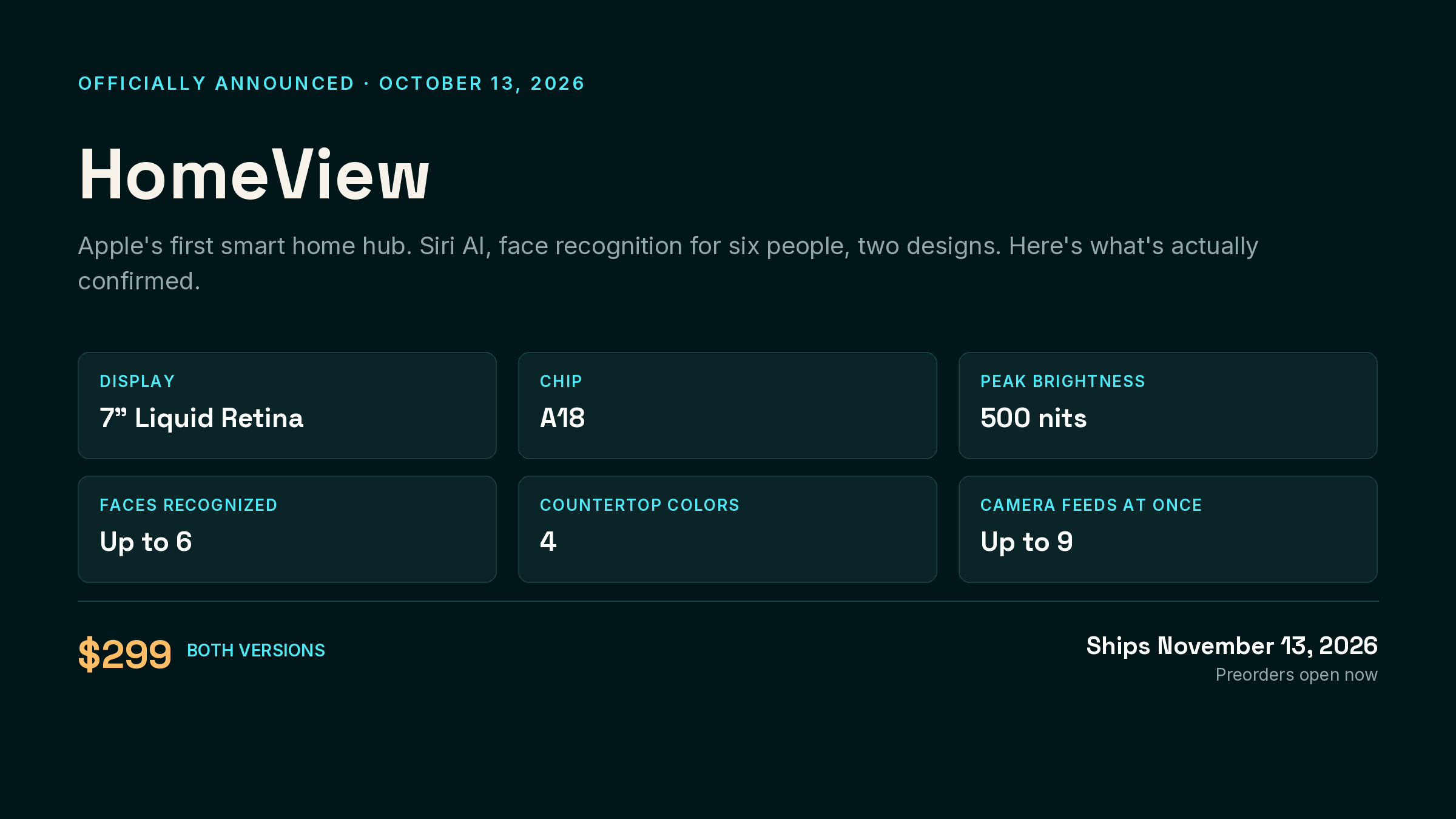
HomeView comes in two versions. The countertop model has a speaker base and comes in Silver, Starlight, Rose Pink, and Space Gray. The wall-mounted model drops the base entirely and comes in Silver and Space Gray only, and it needs a separate mount that costs $59.95 on top of the hub itself. Both run Apple's A18 chip and both cost $299. The screen is a 7-inch Liquid Retina touchscreen that peaks at 500 nits and dims all the way down to 0.3 nits, low enough to sit on a nightstand without lighting up a dark room. The countertop version adds two full-range drivers, a down-firing woofer, and two passive radiators for actual room-filling sound.
The headline software feature is face recognition. HomeView can tell up to six people in a household apart and switches to that person's own Home Screen, apps, and widgets the moment it recognizes them. Pair it with an iPhone or iPad running Apple Intelligence and it pulls in personal notifications and calendar data too, so the hub on the kitchen counter actually knows whose day it's looking at. There are Apple Watch-style custom faces as well, with four adjustable widgets for things like weather, favorite photos, or Snoopy animations.
Full announcement writeup, pricing, and release details.
Breakdown of both designs, all six color options, and the full spec sheet.
Everything above comes directly from Apple's own announcement and matching spec coverage. Not leaked, not projected.
Siri AI is the actual pitch here
The hardware is almost beside the point. Apple is selling HomeView as what Bloomberg's Mark Gurman called a "Siri command center for an Apple-powered household." Siri AI is supposed to bring broader world knowledge and onscreen awareness, meaning it can reason about what's actually showing on the display in front of it, not just answer a voice command in isolation. Apple says camera and microphone data stays isolated through Secure Enclave, and that Siri requests run either on-device or through Private Cloud Compute, which the company says doesn't store the data or make it accessible to Apple itself.
There's one real catch worth knowing before you get excited: HomeView is not launching in the European Union yet, because Siri AI isn't currently available on iOS there. If you're an EU reader waiting on this, the hub itself isn't the bottleneck, the software is.
The EU delay and its stated reason come directly from Apple's own release details, not a leak.
No App Store at launch
This is the part most likely to catch early buyers off guard. According to Gurman's reporting, HomeView ships with a limited set of Apple's own built-in apps and no App Store for downloading anything beyond that. Third-party accessories get controlled through Matter and Thread, the Home app, and Siri itself, not through installable software the way an iPad or Apple TV works. No timeline has been reported for Apple adding an App Store later, so treat this as how the device works at launch, not a temporary gap with a known fix date.
Full writeup of Gurman's reporting on the App Store omission.
The no-App-Store detail is Gurman's reporting, not an Apple statement, though Gurman's Apple sourcing has a strong track record. Whether this changes after launch is unconfirmed either way.
The Apple Home Collection: LG and Schneider Electric join in
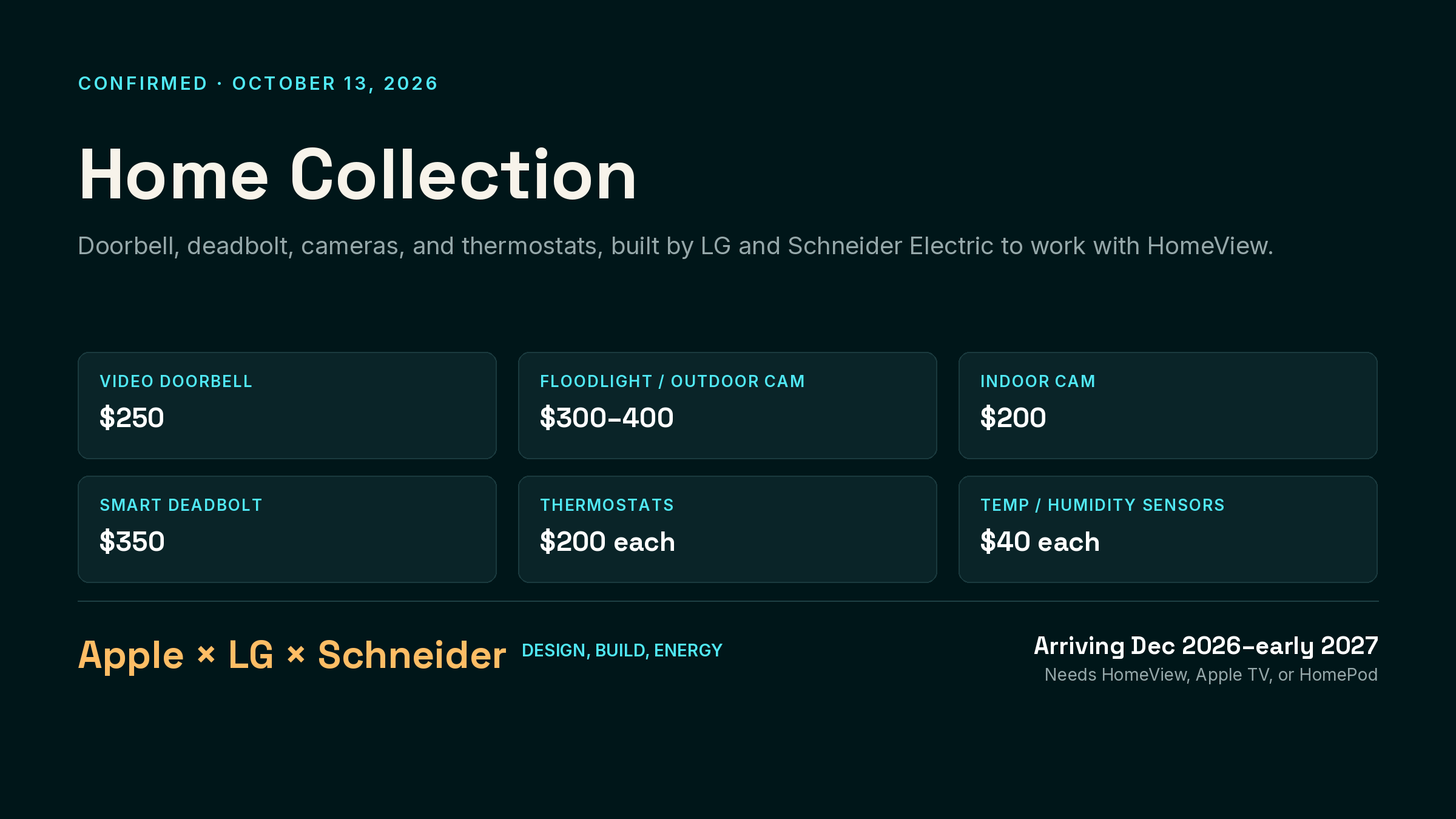
HomeView isn't shipping alone. Apple is launching an umbrella line called the Apple Home Collection, with LG manufacturing the security and entry hardware and Schneider Electric building energy devices for European markets. Everything is built on HomeKit and Thread, sets up with a single tap, and is managed through the Home app, though some features need a hub like HomeView, Apple TV, or HomePod to work. Apple says the data is encrypted so that neither Apple, LG, nor Schneider can read it.
Graphic: Actually Useful Tech, sourced from Engadget's full pricing rundown.
The lineup covers a wired video doorbell at $250, a floodlight camera at $400, an outdoor camera at $300, and an indoor camera at $200 that auto-tilts depending on whether anyone's home. There's a smart deadbolt at $350 with UWB auto-unlock that keeps working locally over Matter and Aliro even if Wi-Fi drops, plus thermostats and temperature sensors from LG and Schneider at $200 and $40 respectively. Camera footage stores in iCloud at no extra cost, with ten days of event history, and higher iCloud+ tiers add Apple Intelligence video descriptions and natural-language search. None of this hardware ships alongside HomeView itself. Most of it is expected in December 2026, with the rest landing in early 2027.
Full pricing and feature breakdown for every Apple Home Collection device.
What people who follow Apple closely are saying
Six Colors' Jason Snell, who's tracked Apple's smart-home rumors for years, pointed out that the HomeView name traces back to a trademark Apple quietly filed through a shell company last year, and that he'd personally guessed wrong that Apple would just reuse the HomePod name for this.
"The Siri command center for an Apple-powered household."
Mark Gurman, via Six Colors, Oct 2026Snell also flagged that the Apple TV remote is reportedly getting its own speaker, with Apple TV itself gaining a microphone to take Siri requests directly. Read next to HomePod mini 2 launching at $149 with Siri AI arriving later via software update, the pattern is hard to miss: Siri AI isn't a HomeView-only feature, it's rolling out across the living room over the next several product cycles, with HomeView first in line.
The Apple TV remote and microphone details come from Gurman's reporting via Six Colors, not an Apple announcement. No date has been attached to either.
Where this leaves Amazon and Google
It's worth being direct about the timing here. Amazon's Echo Show and Google's Nest Hub have had roughly a decade to refine the smart display category, work out their own app and skill ecosystems, and settle into whatever price-to-feature ratio actually sells. Apple is arriving late, more expensive at the low end, and without an App Store on day one. What Apple has that neither competitor can fully match is a hardware partner building a matching accessory line specifically for this hub, face recognition tied to six individual profiles instead of one shared account, and an AI pitch built around on-device and Private Cloud Compute processing rather than sending everything to a server by default.
This section is our own read of the competitive picture, not sourced analyst commentary. Treat it as informed opinion, not a reported fact.
Should you wait for it
No score, on purpose, because nobody outside Apple has lived with one yet. But here's the honest shape of the decision. If you're already deep in Apple's ecosystem, want face recognition that actually knows which family member is standing in the kitchen, and don't mind a closed app environment on day one, $299 is a fair price to be an early adopter with. If you're waiting on third-party app support, the Apple Home Collection accessories that give the hub something to actually control, or just want to see whether Siri AI performs outside a keynote demo, the smart move is to let November's first wave be someone else's purchase and revisit this once real units and real accessories are both out in the world.